Hawaii Big Island, Hawai'i Volcanoes NP Feb-2026
Feb 8 - 15, 2026
Sunday, Feb 8
🌧 Weather: Good travel weather, But heavy rain on way to Hilo.
🛪 Travel Day
O’Hare – Denver – Kona. The flight to Denver was a little over 3 hours, and the flight to Hawaii was about 7 hours — long but uneventful. The drive from Kona to Hilo took about an hour and a half. The first half was easy; the second half was dark with a steady downpour. We made it to the hotel safe and sound.
🏨 Grand Naniloa Hotel - Hilton DoubleTree
The hotel was just OK. We booked through Costco Travel and were expecting more of a resort. It kind of was… but really felt more like a lower-end DoubleTree. The pool is tiny and there’s no beach, although it is oceanfront. The room did have a great ocean view and a nice balcony, which we enjoyed.
We did have one big issue. At check-in, we requested housekeeping every other day. Well… they didn’t clean the room. Each day it went uncleaned we contacted them and asked for service. Each day they said OK. Each day they didn’t clean. We checked in on Sunday and the first (and only) cleaning was on our last day — Saturday. On Friday I complained pretty firmly and got our week of valet parking (about $200) waived. Squeaky wheel! It worked out in the end.
Monday, Feb 09
🌧 Weather: 70s, Rain all day.
Breakfast at the Hotel
Had a nice breakfast at the hotel and a lazy morning with all the rain. Here are some pictures of the hotel grounds and one amazing tree just down the road.


Kaumana Caves State Park
About Kaumana Caves
This park offers a quick diversion into a lava tube. You descend a metal ladder through a skylight into a lava tube created by an 1881 flow from
Mauna Loa. You can read more about it here:Kaumana Caves.
We explored only a small portion of the cave. It was extremely dark, and our cell phone flashlights barely penetrated the darkness. You couldn’t see where you were stepping, and the terrain was rough lava rock. It was really cool — but we kept it short and only explored a small section.


Wailuku River State Park - Rainbow Falls
About Rainbow Falls
Rainbow Falls, locally known as Waiānuenue Falls, is a captivating 80-foot waterfall nestled along the lush banks of the Wailuku River in Hilo, on the Big Island of Hawai'i. Named for the spectacular rainbows often visible in its misty spray during sunny mornings, this waterfall is a picture-perfect stop for nature lovers, families, and photographers alike. Depending on recent rainfall, Rainbow Falls can range from a gentle, serene cascade to a mighty, roaring torrent plunging into a tranquil blue-green pool. You can read more about it here: Rainbow Falls.
Just short walks to the viewing areas. Spectacular falls!


 VIDEO
VIDEO 


 VIDEO
VIDEO 


 VIDEO
VIDEO 


Views from our hotel Balcony

.jpg)


Dinner: Jackie Rey's
Went to Jackie Ray's for a nice dinner. Tasty!


Tuesday, Feb 10
🌧 Weather: 70s, Some rain, but not too bad! Some clear times, some just a light drizzle and a rainbow!
Kapohokine Adventures -- Evening Volcanoe Explorer
We booked the Evening Volcano Explorer tour. Our guide, Sam, picked us up at the hotel, and with only three other people along, it turned into a nice, small, friendly group.
Kaimu Bay
About Kaimu Bay
Kaimū and Kaimū Bay, located on the southeastern (Puna) coast of the Big Island, were once known for their beautiful black sand beach lined with coconut palms. In 1990, lava flows from nearby Kīlauea buried the original beach and much of the surrounding community under many feet of lava. What had been a crescent of sand and palm trees became a stark, hardened lava landscape meeting the sea.
Today, Kaimū is a powerful example of Hawai‘i’s constantly changing geology. New black sand has slowly begun forming in pockets along the shoreline, and palms have been replanted, but the area remains rugged and raw. Walking there feels less like visiting a traditional beach and more like standing on brand-new earth — a reminder that on this island, creation and destruction happen side by side. 🌋🌊 (ChatGPT)
Kaimu Bay - Walking in a Lava Lanscape
Our first stop was a hike across the Kaimu Bay lava landscape to the ocean. We were walking on land that didn’t exist a few decades ago — a vast expanse of hardened lava meeting the sea. Stark, raw, and quiet. Otherworldly.
.jpg)


 VIDEO
VIDEO  VIDEO
VIDEO 


 VIDEO
VIDEO 


Star of the Sea - Painted Church
Next stop was a church that had been relocated to get out of harms way of the lave flow. Kind of boring but we only spent a few minutes there.


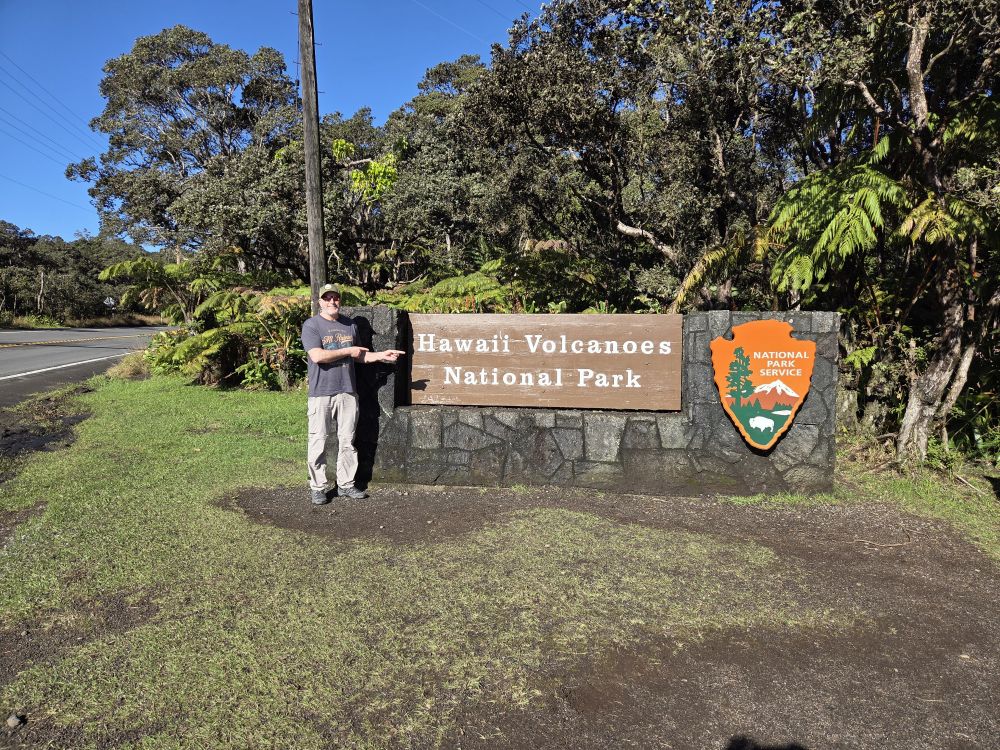
Hawai'i Volcanoes National Park - Volcano House
Next stop is the National Park! We made a brief stop at the Volcano House (lodge, restaurant and gift shop) to get our first views of Kilauea, Wow! Great vantage point on the rim of the crater. You can see the many steaming vents


About Hawai'i Volcanoes National Park
Nature
Well-known for its volcanic and geological significance, Hawaiʻi Volcanoes National Park is also one of the most fascinating biological landscapes
in the world. Located more than 2,000 miles from the nearest continental land mass, the Hawaiian Archipelago is the most geographically isolated
group of islands on Earth. Hawaiian plants and animals began to evolve over 70 million years ago in nearly complete isolation and over 90% of the
native terrestrial flora and fauna in Hawaiʻi are found only in the Hawaiian islands. This level of endemism surpasses all other places on Earth—
even the Galapagos Islands.
Volcanoes
Volcanoes are monuments to Earth's origins, evidence that its primordial forces are still at work. Over time, these prodigious land
builders have created the Hawaiian island chain itself. Kīlauea and Mauna Loa are still adding to the island of Hawaiʻi and put this
incredible phenomenon on full display.
Kīlauea is the youngest and most active volcano on the island of Hawaiʻi, and one of the busiest in the world. In recorded history, Kīlauea has only had short periods of repose. It has covered almost 90% of its surface in lava flows within the last 1,000 years. Some say that even the name Kīlauea translates to “spewing" or "much spreading”.
First forming underwater roughly 280,000 years ago, Kīlauea is a fairly typical shield volcano with long, shallow slopes. Its surface makes up an area slightly smaller than the island of Oʻahu.
Eruptions
Kilauea has been erupting episodically about every two weeks since December, 2024 with eruptions lasting from five hours to three days.
Manunaulu Hike
Next up on Chain of Craters Road was Maunaulu and the Forest Loop hike. Once again, we felt like we had landed on another planet. Lava everywhere — some of it piled into huge ridges, some split open into deep cracks and ravines. What really amazed us were the native ʻōhiʻa trees. They’re so dense and tough that you can still see where they once stood their ground against the flowing lava. The trees are long gone now, but the hardened lava still shows the outlines where they resisted. And, scatterd on the ground everywhere were pieces of reticulite (a type of extremely vesicular (full of bubbles) volcanic glass that gets blasted into the air during lava fountains) — so light and fragile it can be crushed between your fingers. It looks solid, but it’s mostly air. You can see one Kathryn is holding in the pictures below. Nature is incredible.
And a bonus -- lava under our feet, rainbow over our heads. Another fantastic hike.


 VIDEO
VIDEO Ko'oko'olau Crater
Next stop was Koʻokoʻolau Crater, one of the many along the aptly named Chain of Craters Road. These aren’t typically eruption sites, but places where lava once flowed underground, leaving empty tubes and chambers. Over time, the surface collapses into those gaps, forming the crater. Several still had steam gently wafting out — quiet reminders that the heat is never too far below the surface.


Nahuku Lave Tube
Next stop was the Nāhuku Lava Tube — time to go underground! This one is much more accessible than the Kaumana Cave lava tube we explored yesterday. It’s just a short walk through the tunnel, but how cool is that? Walking through a perfectly round passage carved by flowing lava, hidden beneath a lush rainforest. One minute you’re in thick green jungle, the next you’re inside the earth.


Dinner at Lava Rock in Volcano Village
For dinner Sam took us to the nearby town of Volcano Village to the quaint Lava Rock Cafe which was nice.

Back to the Park!
After dinner, once it was fully dark, we headed back into the park for some nighttime views. Our first stop was Kūkamāhuākea Steaming Vents, where you can walk right up and feel a fresh blast of warm steam rising from the earth. From there, we took a short flashlight hike along the crater rim to the ranger station, where Sam picked us up and drove us to our final stop at the Volcano House. With the volcano nearing its next eruption, lava had been pooling at the bottom of the crater, glowing orange through the steam from the main vent. Unfortunately, it was completely socked in that night, and we didn’t get to see it (more on that on the 15th!).


We highly recommend this tour. We covered a lot of ground and had an incredible experience. Sam, our guide, was knowledgeable on so many topics: The Hawaiian Island archipelago, the Big Island, the culture, the history, the people, the geology, the volcanoes, the eruptions, the flora and fauna. Thank you Sam!
Wednesday, Feb 11
🌧 Weather: 70s, Lots of Rain!
Lunch
Easy morning then headed out to Akaka Falls State Park. On the way we stopped in the tiny town of Honomu to have lunch at tiny restaurant The Hive. Found a table outside and enjoyed our light lunch.


Akaka Falls State Park
Akaka Falls State Park is a rain forest with two impressive falls.
From the web site:
"Marvel at the main attraction, a stunning 442-foot waterfall, as it gracefully plunges into a gorge, creating a breathtaking display of
natural beauty and power.
Embark on a short, paved loop trail that winds through a lush tropical rainforest, offering panoramic views of the waterfall and
showcasing the diverse flora, including orchids, bamboo groves, and the picturesque Kahuna Falls.
Capture the beauty of vibrant orchids, rainbow eucalyptus trees, and other native foliage, making Akaka Falls State Park a haven for nature
photographers and enthusiasts alike."
When we got there it was raining hard, which was perfect for hiking in a rain forest! We donned our rain coats and did the short loop hike through the lush rain forest with great views of both waterfalls. Loved it!


.jpg)


 VIDEO
VIDEO 
 VIDEO
VIDEO 


 VIDEO
VIDEO 


 VIDEO
VIDEO Dinner at Moon and Turtle
We went into downtown Hilo for dinner at Moon and Turtle. The staff was great and the food was excellent. Highly recommended!


Thursday, Feb 12
🌧 Weather: 70s, Another rainy day!
Not a big plan for today. We watched a lot of the Olympics (go USA!) since the weather was pretty poor.
Liliuokalani Gardens and Hilo Bay Cafe
Right near our hotel are the Liliuokalani Gardens. We walked the gardens in light rain. Some very cool trees we don't see at home.
Across the street and on the ocean front is the Hilo Bay Cafe where we enjoyed a quite lunch on the deck overlooking the ocean. Tasty!


Dinner at the Hotel
For Dinner we just went to the Hotel Bar / Cafe and had some small plates overlooking the grounds and the ocean. Nice.


Friday Feb 13
🌤 Weather: 70s, Partly cloudy.
A few early morning views from our balcony...blue skies...finally!


Hawaii Volcanoes National Park
With no rain in the forecast, it was time to head back to Volcanoes National Park to explore and hike on our own. We got an early start after hearing that parking inside the park can get congested. Just an easy 45-minute drive from Hilo, we rolled in at 9:00 a.m. with no traffic issues at all.

First quick stop was at the Steaming Vents we had visited on the tour.


 VIDEO
VIDEO The Visitor Center is currently closed for a major rebuild, so we stopped instead at the temporary Welcome Center at Kīlauea Military Camp to talk through hike options with a ranger who (as always) helped us fine-tune our plans for the day. A guided ranger tour was starting in just a few minutes, so we joined her for a short walk through the forest to the crater rim. Along the way, she pointed out native Hawaiian plant species and shared some history about the park’s central figure — the volcano deity Pele and her Kīlauea volcano. Ranger hikes are always worth it.


Kilauea Overlook
Driving nearly to the end of Rim Drive West we stopped at one of the best and closest viewing sites of Kilauea.

 VIDEO
VIDEO 

 VIDEO
VIDEO 

Kilauea Iki Hike
The Kīlauea Iki Trail descends about 400 feet into the crater, crosses the crater floor, and then climbs 400 feet back up to the rim — a total distance of roughly four to five miles. This was an amazing hike unlike anything I’ve experienced before. Walking across volcanic rock at the bottom of an active crater — it doesn’t get much better than that. If you look closely at some of the photos, you can see just how small the people appear against the vast crater walls. You can also spot the rock cairns scattered across the crater floor, marking the path of the trail.


 VIDEO
VIDEO 


Chain of Crater Road to the Pacific and the Holei Sea Arch
After the hike we completed driving Crater Rim Drive East and then drove the length of Chain of Craters Drive down to the coast (~45min). Then a short hike to view the Holei Sea Arch carved out by the surf.


Dinner in Volcano Village - Lanikai Brewing Company
After the arch we drove back to Volcano Village and found the Lanikai Brewing Company and had some good beer and a casual dinner. A good way to end a great day!


Saturday, Feb 14
🌧 Weather: 70s, Rain, but not too bad!
Pacific Tsunami Museum - Hilo
Hilo claims to be the tsunami capital of the world, receiving waves from all across the Pacific Ocean. They can be especially intense here because of the island’s geometry, which creates a “V”-shaped funnel opening toward the Pacific right at Hilo. You can read more about the museum and tsunamis here: Pacific Tsunami Museum.
We listened to a docent who explained why Hilo is such a target and shared stories of the major tsunamis that have struck the city over the years. It was an interesting and informative talk. We also briefly sat in on another lecture about wave mechanics… but it was boring! so we bailed. We toured the small museum afterward and watched a compelling video. A nice museum with a truly unique subject.
Pana'ewa Rain Forest Zoo & Gardens
After the museum, we visited the small but interesting Panaʻewa Rainforest Zoo & Gardens. It was raining again — but, hey, it’s a rainforest, so I guess that makes sense. Wandering the grounds, we saw a variety of tropical plants and animals tucked into the lush greenery. A nice little zoo and a perfect stop on a rainy Hilo afternoon.
Unfortunately, with all the fencing, the pictures are not great.


Sunday, Feb 15
🌤 Weather: 70s, Partly cloudy.
Hawai'i Volcanoes National Park - Eruption Hunting
All week we had been monitoring the USGS website for predictions of Kīlauea’s next eruption. Since December 2024, eruptions have been occurring episodically about every two weeks. One key indicator of an impending event is inflation of the mountain. Using highly sensitive instruments, scientists measure tiny changes in elevation — just millimeters — caused by magma pushing up from below. When we arrived in Hawaiʻi, the predicted window was February 12–15, but a couple periods of deflation shifted that estimate to February 15–17.
Today was our flight home, leaving early in the afternoon, so we decided to get up well before sunrise and head back into the park one last time. We wanted to see the orange glow in the steam from lava pooling on the crater floor — something we had missed earlier due to weather. And, of course, we were quietly hoping we might catch the eruption before we had to leave.
We arrived at Kīlauea Overlook at 5:45 a.m. (sunrise was 6:30) and were not disappointed. The orange glow shining through the venting steam before dawn was an incredible sight. On its own, it was worth the early alarm and the extra drive — in the opposite direction from the airport, no less. We stayed as long as we could, but by 9:30 everything was still quiet, and it was time to head out and catch our flight.

 VIDEO
VIDEO 


 VIDEO
VIDEO 
 VIDEO
VIDEO When we landed at LAX, I immediately checked the USGS website. Kīlauea had begun erupting at 1:50 p.m. We missed it by just a few hours. Disappointed? Sure. But Pele decides when she wants to send lava fountains 1,300 feet into the air — not me.
Kilauea - Links to view the eruption
Here are a couple of links for the eruption:
Kilauea Eruption Feb 15, 2026Kilauea Eruption Feb 15, 2026
Return Home
Flight was Kona (2:08p) to LAX (5 hours) to ORD (4 hours) arriving at 5:00a (next day) with the 4 hour time change. Long travel day!
Home Sweet Home.
Summary
- 🌴Hawai'i Big Island- Beautiful, rain forests were spectacular.
- 🌴Hilo- Nice, easy to get around city but, rains 120" per year! That's a lot!!
- 🏨Grand Nanoli Hotel- Disappointing, terrible house keeping, tiny pool, no beach.
- 🌋Hawai'i Volcanoes National Park- Awesome.
- 🌋Kilauea- Awesome.